
Keep Bermuda Beautiful (KBB) is a non-profit organization with a mission to engage individuals to…
The Institute for Food and Development Policy better known as Food First envisions a world in which all people have access to healthy, ecologically produced, and culturally appropriate food. The mission of Food First is to end the injustices that cause hunger. Their work includes action-oriented research, publications, and projects – gives you the tools to understand the global food system, build your local food movement, and engage with the global movement for food sovereignty. Through research, education, and action, Food First supports global and local movements for food sovereignty and empowers communities to take control of their food systems. As a people’s think and do tank,” they are dedicated to ending the injustices that cause hunger and supporting communities to take back control of their food systems. Food First advances their mission through three interrelated work areas: research, education and action.
The goal of this project was to build an interactive StoryMap for Food First’s recent research initiative, Amplifying Grassroots Voices in Food Justice. Food First aims to share this research as widely as possible, and in addition to the StoryMap, they have also adapted the project into a graphic novel. Taylor Mathis was selected as the volunteer to build the StoryMap.
The StoryMap Amplifying Grassroots Voices in Food Justice: Global Struggles and Local Strategies combines publicly available global datasets from organizations including the World Health Organization, LandMark, ND-GAIN, the World Bank, and the Food and Agriculture Organization with original research and materials from Food First’s Amplifying Grassroots Voices in Food Justice project. These include interviews, photographs, and community profiles from 37 participants across Southeast Asia, South Asia, Sub‑Saharan Africa, Latin America, and the United States and Hopitutskwa, along with project-created geographic data and derived layers.
Food First provided the outline, photos, and data for the StoryMap, all based on their research. Taylor created the StoryMap using StoryMap Builder, Web Maps, and Experience Builder. This work incorporated several datasets, including but not limited to, the prevalence of diabetes in 1990 and 2022 from the World Health Organization; global land ownership by Indigenous communities from LandMark; the University of Notre Dame’s ND‑GAIN Index (which measures each country’s vulnerability to climate disruptions); and numerous community stories from grassroots food justice groups around the world that Food First collected. All external datasets are credited in the StoryMap’s Acknowledgements section.
The mission was carried out remotely between March 1 2026 and July 30 2026, for an estimated 146 volunteer hours.

This StoryMap will allow Food First to educate a wider audience about food justice in an interactive and engaging way, highlighting how this is a global issue. It also helps them demonstrate to policymakers that food insecurity is affecting their own communities directly from the perspectives of the people experiencing it.

Beyond public education, the StoryMap gives Food First a durable, reusable asset. The research previously accessible mainly as a long-form report is now available in a format that can be shared in a single link, embedded in the organization’s website, projected during presentations and workshops, and cited by partners and coalition members. It complements the graphic novel adaptation, giving Food First multiple entry points into the same body of work for different audiences: funders, policymakers, community organizations, and students.

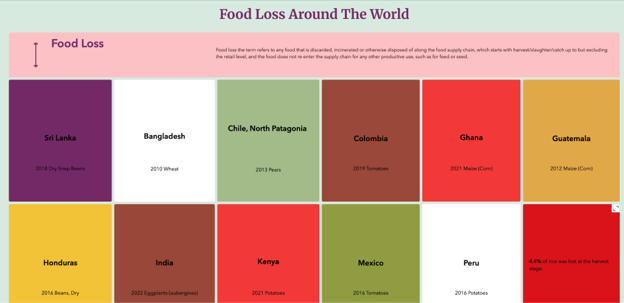

Because the StoryMap is built on hosted layers in Food First’s own ArcGIS Online organization, staff can update the underlying data and add new community stories as the research continues, without rebuilding the narrative. This positions Food First to keep amplifying grassroots voices over time and establishes an in-house mapping capacity the organization can apply to future initiatives.
To support long-term sustainability, Food First staff received live training and documentation on updating StoryMap content, maps, and images, as well as adding new community stories using existing templates. This enables Food First to independently maintain and expand the StoryMap as its research evolves.
Project Complete.

Related Missions


